


 by Konstantin
  18 Aug, 2025
 What should every navigator know?
The navigator is the “brain” of the bridge watch: the safe course, timely decisions, and the calm of the entire crew depend on them.
Below is a concise yet “live” cheat sheet: what you really need to know and do every day on the bridges of modern vessels.
I. The navigator’s baseline worldview
- Most of global trade moves by sea — so every precise decision on watch carries global weight. According to UNCTAD, about 80% of world trade by volume is carried by sea.
- The key “three pillars” of safety: COLREG (rules to prevent collisions), SOLAS V (navigational safety and passage planning), STCW (training, watchkeeping, rest). Every point below directly relies on these documents.
II. Passage planning: berth to berth
A plan is not a formality but “insurance” against mistakes. IMO A.893(21) defines four stages: appraisal » detailed planning » execution » monitoring. The plan must cover the entire route “from berth to berth” and take into account routes, weather, tides, draft limits, TSS, VTS, and pilotage.
Mini-checklist before going to sea (SOLAS V/34):
- Up-to-date charts/publications for the entire route;
- Prepared alternate routes;
- Specific measures for narrow waters, fog, icing, etc.;
- An agreed BRM plan: who does what at each phase.
III. Lookout and speed: the “rule #1” at sea
Under COLREG Rule 5 every vessel must always maintain a proper lookout by all available means — eyes, hearing, RADAR/ARPA, AIS, ECDIS overlays. This is not “for show,” it is about timely awareness of collision risk.
In practice:
- In fog — hand steering, adjusted speed (Rule 6), deploy an additional visual lookout, set RADAR/ARPA to longer ranges and use parallel indexing of targets.
IV. Watchkeeping and rest: keeping the “human factor” at bay
STCW requires at least 10 hours of rest in every 24 hours and 77 hours in 7 days (with defined splits). Disrupted sleep directly raises risks on the bridge. Schedule so the most experienced work at night, and reinforce the bridge in constrained waters.
Good to know: the IMO Guidelines on Fatigue explicitly recommend integrating fatigue management into the Safety Management System (ISM). Include fatigue in briefings and track “red zones” of changing sleep hours.
V. Electronic navigation without self-deception: ECDIS, ENC, updates
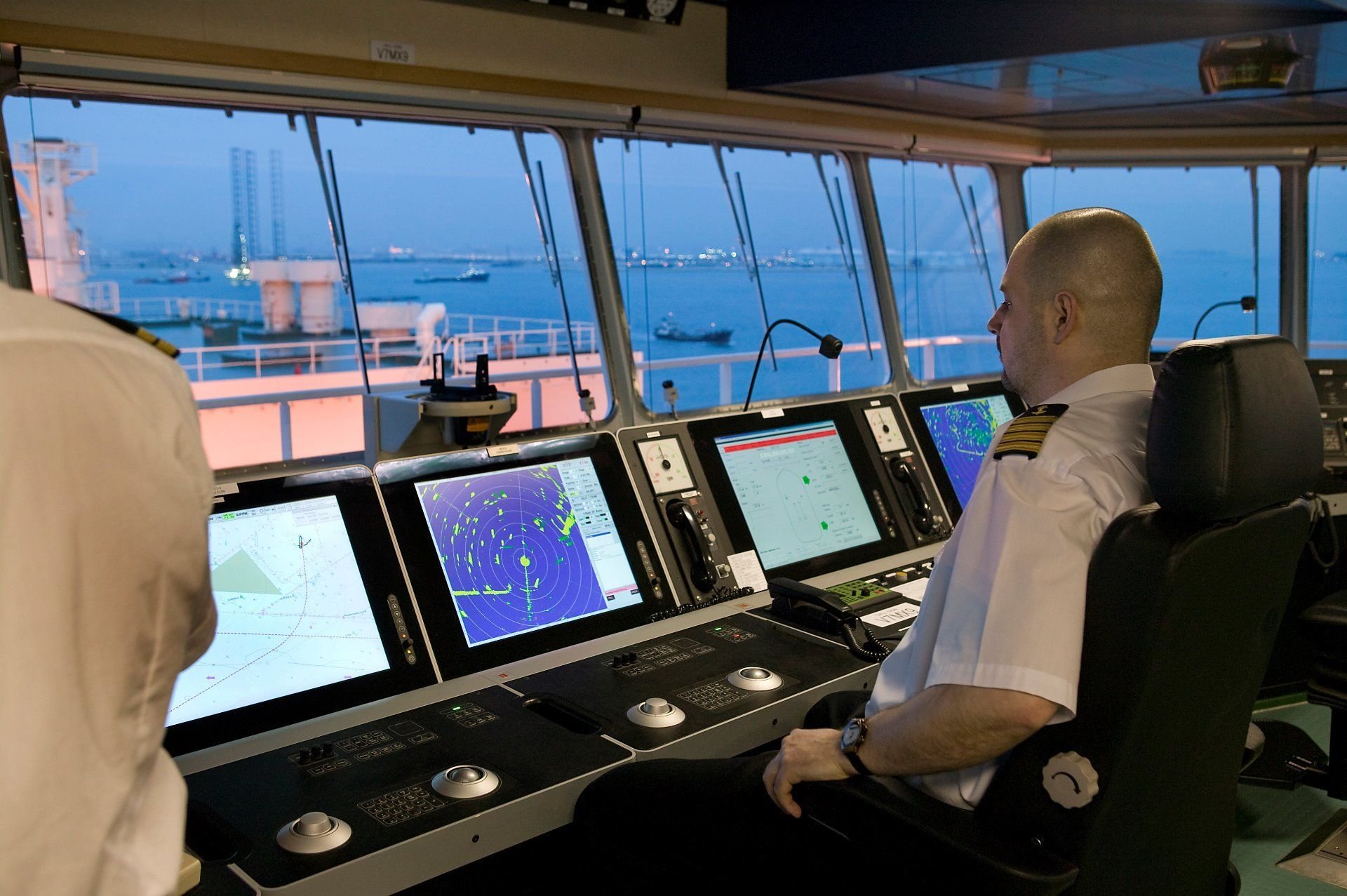
- For most large ships ECDIS is mandatory under SOLAS V/19; it must be operated with official ENCs and an appropriate backup (a second system or paper charts, depending on ship policy).
- Vector ENCs vs raster RNCs: vector charts (ENC) are an “intelligent” object database; raster charts are a “scan” of a paper chart. For a truly paperless mode you need ENCs; RNCs are allowed in RCDS mode only under specific conditions.
Practice tip: keep databases, PPUs and ECDIS firmware up to date; periodically drill a loss of GNSS with a switch to RADAR position lines and visual marks.
VI. Radio and distress: the essence of GMDSS in a nutshell
GMDSS is an integrated system designed to ensure that no distress call “disappears.” On international voyages, passenger and cargo ships of 300 GT and above must carry specified equipment (EPIRB, NAVTEX, etc.) depending on sea area (A1–A4). Knowing the call priorities (MAYDAY/PAN-PAN/SÉCURITÉ) and their phraseology is every navigator’s duty.

VII. Pilot and bridge: information exchange that saves
A pilot is the local-conditions expert, but the master and bridge team remain responsible at all times. IMO A.960 requires an effective Master–Pilot information exchange (MPX) and a BRM approach throughout the entire entry/exit. Keep the pilot card, maneuvering limits, draft/UKC, thrust/speed — at your fingertips.
VIII. The “quiet math” near the bottom: draft, UKC, squat, bank effect
In narrow/shallow waters a ship squats and may be drawn toward the bank by the stern due to the bank effect. Safe speed, adequate UKC, and anticipatory planning are your main allies.
IX. Bridge language: not “guess what I mean,” but SMCP
IMO Standard Marine Communication Phrases (SMCP) remove ambiguity. They also include “maritime numerals”: Nadazero, Unaone, Bissotwo… — useful with weak radio or mixed accents. Proficiency in SMCP is directly tied to STCW certification for navigators.
X. Typical navigator errors — and how to avoid them
- A plan “for inspectors,” not for sailing. » Make a living plan with “decision branches” for weather/system failures.
- Belief in the “omnipotence” of electronics. » Maintain visual/radar navigation skills; train for GNSS failure.
- Underestimating fatigue. » Adhere to 10/77 and implement fatigue-management tools in the SMS.
- “We already know everything” during pilotage. » Conduct a full MPX and voice team roles aloud (closed-loop).
Mini-checklist for the navigator before watch
- Charts/ENCs and notices for today are updated;
- All ECDIS/RADAR alarms set for the situation;
- Entry/exit plan in view (berthing plan — separate);
- Weather/tides/currents checked;
- Crew knows roles; SMCP at hand;
- UKC and speed controlled at critical locations;
- Rest regime within STCW limits.
A few “fun facts” for motivation
- A passage plan is an official SOLAS V/34 requirement, not the master’s goodwill. Even a short transit without a plan is a violation.
- SMCP is not “box-ticking”: knowledge of standard phrases is part of STCW requirements for navigators 500 GT+.
- ECDIS is no safety guarantee without updates: the IMO issued consolidated guidance on “good practice” and mandatory software and chart updates.
Conclusion
A good navigator is not the one who has “seen it all,” but the one who asks the right questions in time, works to the plan, keeps the bridge in a BRM mindset, and is not shy about using SMCP. Add STCW rest discipline, competent use of ECDIS/ENC, and respect for hydrodynamics — and you’ve already covered 90% of the road to a truly safe watch.
Sources and standards this material relies on:
UNCTAD — share of world trade carried by sea. (UN Trade and Development (UNCTAD))
IMO Resolution A.893(21) — stages of passage planning; SOLAS V/34 — plan requirement. (IMO, UK Government)
COLREG Rule 5 — proper lookout; Rule 6 — safe speed (USCG NavCen). (navcen.uscg.gov)
STCW A-VIII/1 — hours of rest; fatigue guidelines (MSC.1/Circ.1598). (ImoRules, IRI | International Registries, Inc.)
ECDIS/ENC: SOLAS V/19, MSC.1/Circ.1503/Rev.1 (good practice), IHO S-66 (ENC vs RNC). (classnk.or.jp, IHO)
GMDSS — overview and equipment requirements (IMO). (IMO)
MPX/BRM in pilotage — IMO A.960(23). (IMO)
UKC, squat/bank — cases and guidance from The Nautical Institute; studies on confinement effects. (Nautical Institute, Vlaams Instituut voor de Zee)