


 by Konstantin
  18 Jun, 2026
 Training alarm on a ship: what a sailor should do without delay
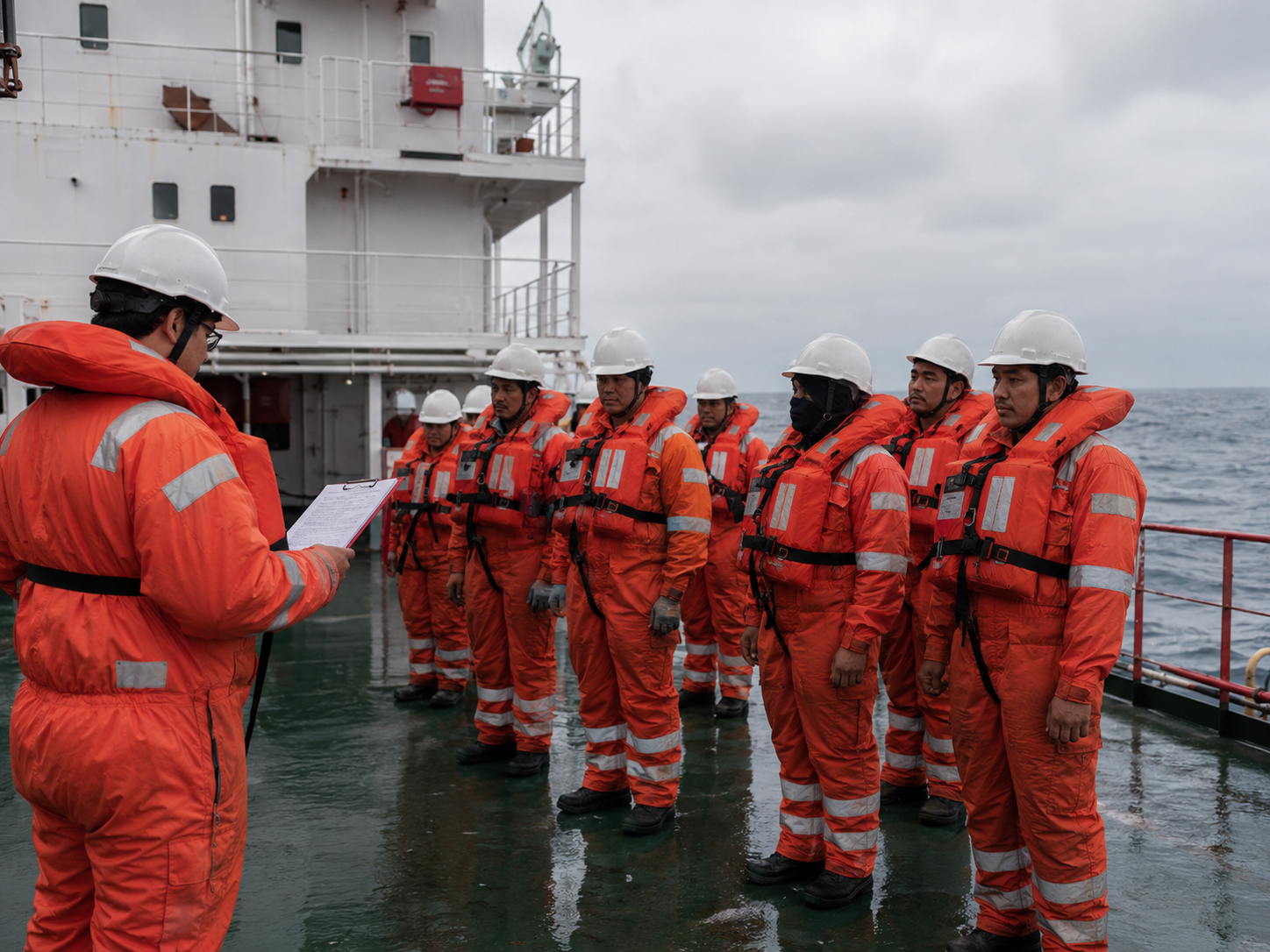
An emergency drill on board is not a formality or a simple check of crew attendance. It shows whether seafarers are able to assemble quickly, perform their duties correctly, and act as one team in the event of fire, flooding, evacuation, or another dangerous situation.
During a real emergency, there may be no time to look for instructions or clarify individual tasks. Therefore, every crew member must know the alarm signals, the route to the muster station, their duties, and the reporting procedure in advance. A correct response during the first few minutes can save lives and prevent the emergency from escalating.
What is an emergency drill on board?
An emergency drill is practical training in crew actions under simulated emergency conditions. During such training, the crew’s response time is checked, along with their knowledge of assigned duties and their ability to use emergency, firefighting, and life-saving equipment correctly.
Scenarios may vary and can include an engine-room fire, a person overboard, water entering the hull, abandonment of the vessel, rescue of a person from an enclosed space, leakage of a hazardous substance, or loss of vessel control.
Regardless of the scenario, the main objective remains the same: to train the crew to act quickly, without panic, and in accordance with the vessel’s procedures.
First rule: every alarm must be taken seriously
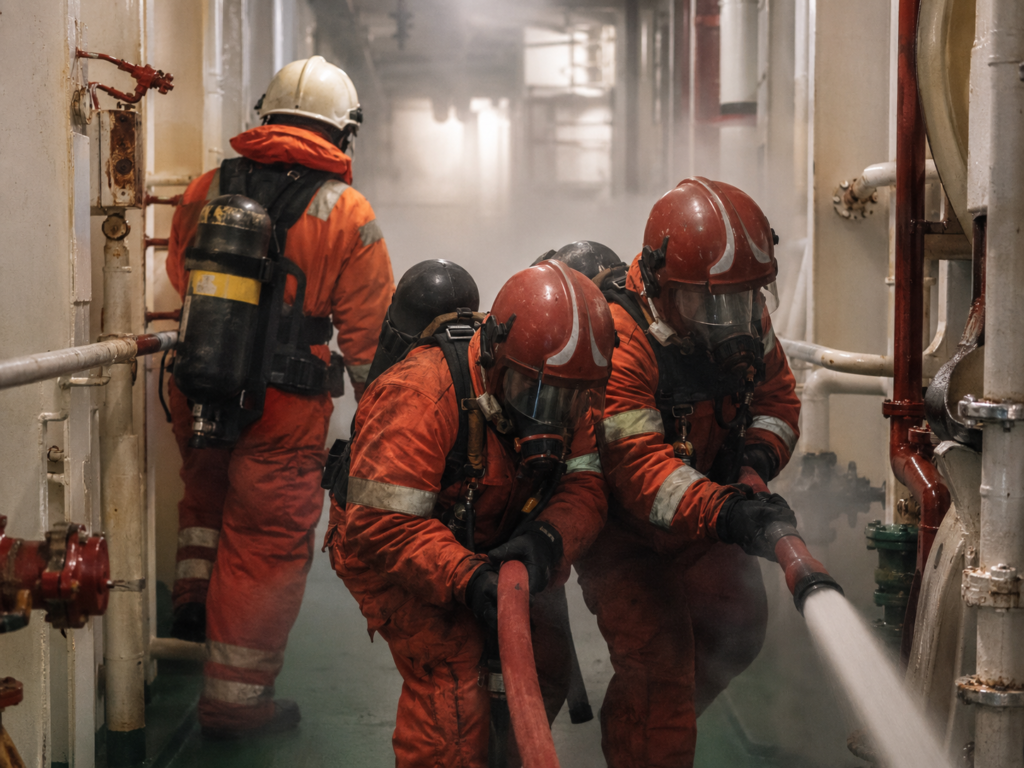
Upon hearing an alarm signal, a seafarer must not wait for someone to personally explain what has happened. They must not continue resting, finish personal tasks, or call colleagues first.
Even if the crew knows that a drill is scheduled for that day, everyone must act as if the emergency were real. This is how the correct automatic response is developed for use in a dangerous situation.
The fact that the alarm is part of a drill does not mean that crew members may move more slowly, ignore required equipment, or report to the muster station only as a formality.
Which signals must a seafarer know?
One of the main signals on board is the general emergency alarm. It is normally sounded as seven or more short blasts followed by one long blast.
After the audible signal, information about the nature of the emergency, its location, and the crew’s next actions may be announced through the vessel’s public address system.
Additional signals may be used on a particular vessel for fire, man overboard, gas leakage, evacuation, or other situations. Therefore, a seafarer must learn the vessel’s alarm signals immediately after joining the ship, not during the first drill.
An alarm signal and an order to abandon ship are not the same. The vessel may be abandoned only after the appropriate order from the master and in accordance with the shipboard procedure.
What must be done immediately after the signal?
Upon hearing the signal, a seafarer must stop the current task, leave the work area in a safe condition if this can be done without risk, and act in accordance with the muster list.
Depending on the type of alarm and the shipboard instructions, it is necessary to:
- identify the signal and listen to the announcement;
- take the required equipment;
- put on appropriate workwear or protective clothing;
- proceed to the assigned muster station without delay;
- report arrival to the responsible person;
- receive instructions and perform only the assigned duties.
A seafarer must not change the route independently, run to the emergency location without orders, or attempt to perform another person’s duties. Uncontrolled actions may interfere with the emergency team and create additional danger.
Muster list: the main document for the crew
The duties of every crew member are defined in the muster list. It states where the seafarer must report, which emergency team they belong to, and exactly what they must do.
Depending on the position, a seafarer may be assigned to:
- fight a fire;
- prepare fire hoses and equipment;
- close doors, ventilation systems, valves, or dampers;
- prepare a lifeboat or life raft;
- check cabins and other spaces;
- count crew members and passengers;
- provide first aid;
- maintain communication between emergency teams;
- operate emergency pumps or other systems.
A seafarer must know their duties before the alarm begins. Simply seeing the muster list on a notice board is not enough. They must understand where the equipment is located, how to use it, and to whom completion of the task must be reported.
How to proceed correctly to the muster station
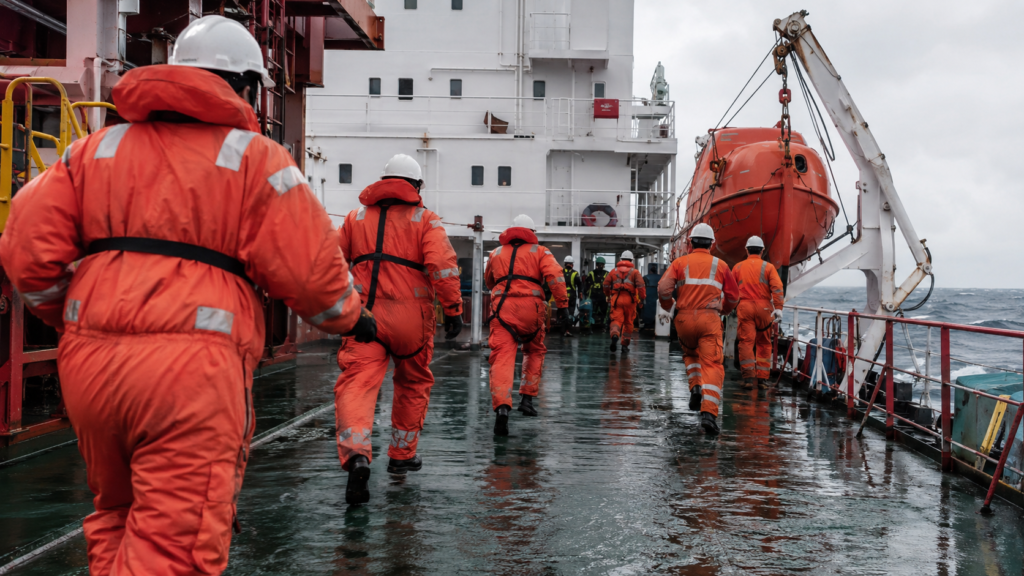
The muster station must be reached by the designated emergency route. A seafarer must know both the primary and an alternative route in advance in case a corridor, stairway, or door is blocked by fire, smoke, or water.
While moving, crew members must not use lifts, push other people, create congestion on stairways, or return to their cabins for personal belongings unless the procedure requires it.
Crew members must listen carefully to announcements, follow the instructions of the officers, and report smoke, blocked passages, injured persons, or any other dangerous conditions.
What should be taken along?
The required equipment depends on the type of alarm and the seafarer’s assigned duties. During an abandon-ship drill, it is usually necessary to have a lifejacket, warm clothing, head covering, and any other equipment specified in the shipboard instructions.
Members of the fire party may be issued protective clothing, helmets, gloves, breathing apparatus, communication equipment, and other specialised gear.
A seafarer must not take suitcases, unnecessary belongings, or items that obstruct movement. In a real emergency, even a short delay caused by searching for documents or personal possessions may have serious consequences.
Reporting arrival and checking personnel
Upon reaching the muster station, a seafarer must clearly report their presence to the responsible person. This is necessary for a rapid headcount and identification of missing persons.
No one may leave the muster station without permission, even if it appears that all required actions have already been completed. If a seafarer leaves independently, they may mistakenly be considered missing, and personnel may be sent to search for them.
If it is known that a crew member is injured or remains in a cabin, the engine room, or another space, this must be reported immediately to the team leader. Returning for the person without orders and the necessary equipment is dangerous.
Actions during a fire alarm
During a fire alarm, rapid reporting, correct assessment of the situation, and a clear division of duties are especially important.
The seafarer who first discovers fire or smoke must immediately raise the alarm, report the exact location, and, if it is safe to do so, use the appropriate first-aid firefighting appliance.
A door must not be opened if a serious fire is suspected inside the space. The entry of air may cause the fire to intensify rapidly. Water must also not be used on live electrical equipment or substances that react dangerously with water.
Crew members must act in accordance with the fire party leader’s instructions, maintain communication, and not enter a smoke-filled area without suitable protection and backup.
Actions during an abandon-ship drill
An abandon-ship drill tests the crew’s readiness for evacuation and use of life-saving appliances.
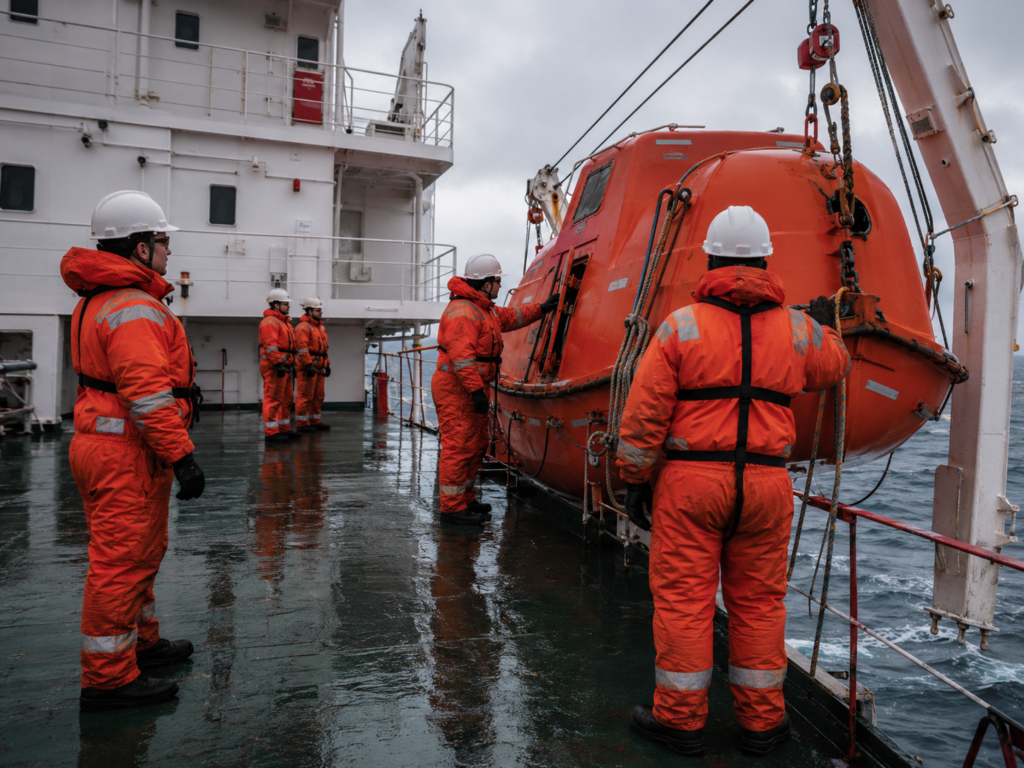
During the drill, seafarers proceed to their assigned muster stations, check that lifejackets are worn correctly, prepare lifeboats or life rafts, and inspect communication equipment, emergency lighting, and other required gear.
Lowering a lifeboat or carrying out other operations may be performed only on command and in accordance with established safety precautions. A drill must not create an actual risk to crew members.
It is strictly prohibited to board a lifeboat without permission, release securing arrangements, start machinery, or leave the vessel independently.
Actions during a “Man Overboard” signal
A person who sees someone fall overboard must immediately shout, “Man overboard,” indicate the side, throw a lifebuoy, and keep the casualty under continuous observation.
The person in the water must not be lost from sight. Their position should be indicated by hand, and any changes must be reported.
Other crew members take their assigned positions in accordance with the muster list and prepare the rescue boat, life-saving equipment, communication equipment, and medical assistance.
What must not be done during an alarm
Even during a drill, incorrect actions may cause injury or disrupt the vessel’s entire emergency organisation.
During an alarm, it is prohibited to:
- ignore or dismiss the signal;
- arrive late at the muster station;
- report without the required equipment;
- leave the assigned position without permission;
- carry out commands that were not given;
- switch on or start equipment without permission;
- joke, interfere with others, or use a phone;
- conceal a lack of knowledge of assigned duties;
- risk one’s life in order to complete a drill task more quickly.
Why clear communication is important
During an emergency, unclear or incomplete information may lead to incorrect decisions. Reports must therefore be brief, clear, and specific.
A report should state what happened, exactly where it happened, what actions have already been taken, and what assistance is required. Unverified assumptions and lengthy explanations should be avoided.
If an instruction is not understood, the seafarer must ask for it to be repeated. It is better to spend a few seconds clarifying an instruction than to perform an important action incorrectly.
What is checked during an emergency drill?
During a drill, the officers assess more than just the speed at which the crew assembles. They check the readiness of personnel, equipment, and the entire emergency response system.
Attention is usually paid to:
- crew members’ arrival time;
- knowledge of alarm signals and routes;
- availability of the required equipment;
- correct use of equipment;
- coordination between emergency teams;
- quality of communication and reporting;
- compliance with safety precautions;
- the crew’s ability to act without panic.
After the drill, it is important to review any mistakes. If a seafarer did not know the assigned task, could not locate equipment, or misunderstood an instruction, the issue must be corrected before the next drill.
What must a seafarer check after joining a vessel?
The required information must be learned during familiarisation with the vessel. A seafarer must not postpone this until the first emergency drill.
After joining the vessel, the seafarer must determine:
- which alarm signals are used on board;
- where the assigned muster station is located;
- which duties are listed in the muster list;
- where the lifejacket and protective equipment are stored;
- the primary and alternative evacuation routes;
- where fire extinguishers, fire stations, and emergency exits are located;
- to whom reports must be made during an alarm;
- how to use the shipboard communication equipment.
Why simulator training matters
Theoretical knowledge of procedures is essential, but it does not replace practical training. During a real emergency, a seafarer may face smoke, noise, poor visibility, limited time, stress, and conflicting information.
Simulator training allows emergency actions to be practised in safe conditions and teaches seafarers how to use equipment, work as a team, and make decisions under pressure.
The more correct actions a seafarer performs during training, the less time will be needed to respond during a real dangerous situation.
The main points to remember
After an alarm signal, a seafarer must act without delay, but not chaotically. The signal must be identified, the announcement heard, the required equipment collected, the designated route followed to the muster station, arrival reported, and duties performed in accordance with the muster list.
No one may leave the muster station independently, interfere with the work of other emergency teams, or carry out dangerous operations without orders. An emergency drill should be as close as possible to a real situation, but all actions must be performed in accordance with safety rules.
Emergency readiness does not begin after the alarm sounds. It begins when a seafarer boards the vessel, studies the muster list, locates the assigned equipment, and understands their role in the vessel’s overall safety system.
Sources: International Maritime Organization (IMO), International Convention for the Safety of Life at Sea (SOLAS), SOLAS Chapter III — Life-saving appliances and arrangements, Muster List and Emergency Instructions, shipboard safety management system procedures.