


 by Konstantin
  01 Jul, 2026
 Ammonia as a marine fuel: new risks the crew must be prepared for
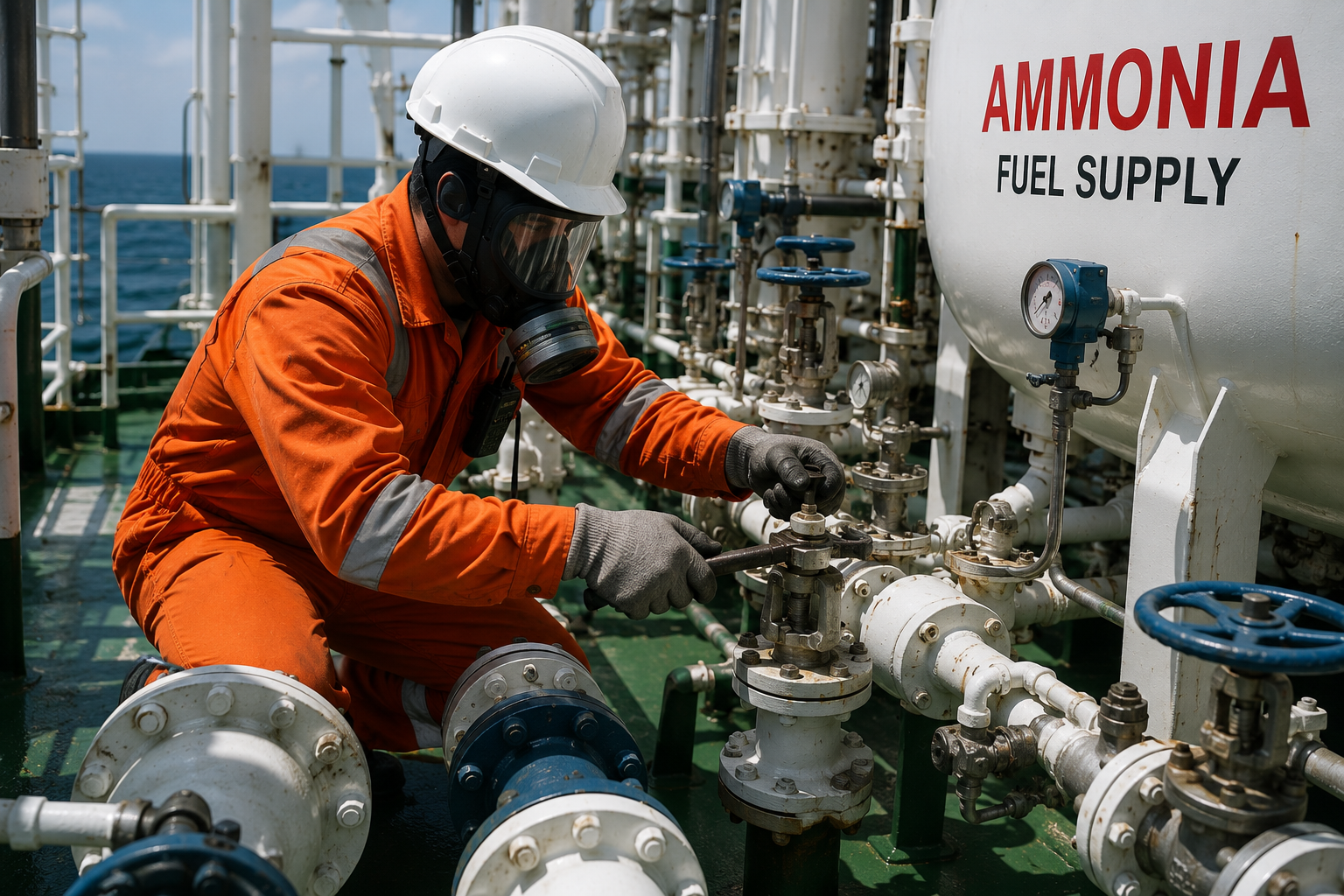
Ammonia is increasingly being considered a promising marine fuel for reducing greenhouse gas emissions. It contains no carbon in its molecule, so its use as fuel does not directly produce carbon dioxide. However, this does not make ammonia automatically safe or completely environmentally friendly.
For the crew, the transition to ammonia means working with a toxic, corrosive, and potentially explosive substance. Even a relatively small leak can create a hazardous atmosphere, restrict evacuation routes, and endanger people who do not have appropriate protection.
Therefore, the safety of an ammonia-fuelled ship depends not only on the design of the fuel system. It also depends on whether the crew can correctly recognise the hazard, respond to a gas-detection alarm, use protective equipment, and act without improvisation.
Why is ammonia being considered as a marine fuel?
The maritime industry is looking for fuels that can help reduce greenhouse gas emissions and gradually decrease dependence on conventional fuel oil and diesel fuel. One possible option is ammonia — a chemical compound of nitrogen and hydrogen with the formula NH3.
Ammonia can be used in internal combustion engines, auxiliary power units, or other shipboard systems. Its main advantage is considered to be the absence of carbon in the molecule.
However, the overall environmental impact depends on how the ammonia is produced, the energy used, transportation, storage, and emission control during engine operation. Particular attention must be paid to nitrogen oxides, nitrous oxide, and the possible release of unburned ammonia.
How does ammonia differ from conventional marine fuel?
When working with diesel fuel, the crew mainly focuses on fire hazards, spills, and pollution. With ammonia, toxicity becomes the primary concern.
Ammonia may be present in liquid or gaseous form. When containment is lost, liquefied ammonia evaporates rapidly, cools surrounding surfaces, and forms a toxic cloud. Its dispersion depends on temperature, ventilation, wind, equipment location, and the ship’s design.
This means that a person must not determine a safe direction based only on smell or personal assumptions. Decisions must be based on readings from fixed and portable gas detectors, the shipboard response plan, and instructions from the responsible person.
The main risk — toxic exposure
Ammonia irritates the eyes, skin, and respiratory tract. High concentrations can cause chemical burns, severe coughing, suffocation, lung damage, loss of consciousness, and death.
The danger is not limited to being directly near the leak. Vapours may enter adjacent spaces through doors, ventilation openings, air intakes, service penetrations, or leaks.
Ammonia’s characteristic pungent odour may warn of its presence, but smell is not a means of control. During prolonged exposure, a person’s ability to detect ammonia may decrease. In addition, the concentration may already be dangerous before the seafarer correctly assesses the situation.
If a person experiences irritation of the eyes, throat, or respiratory tract, they must not remain in the area to search for the source of the leak. They must immediately leave the hazardous zone by the designated route and report the situation.
Contact with liquid ammonia
Liquid ammonia presents a double hazard. It is corrosive to tissue and can cause cold injuries due to rapid evaporation and a significant drop in temperature.
Contact of liquid ammonia with the skin or eyes can cause severe burns. Contaminated clothing can also continue to hold the substance close to the body and generate hazardous vapours.
For this reason, decontamination showers and eyewash stations must be provided near bunkering stations, exits from fuel preparation rooms, tank connection spaces, and other hazardous areas.
Ammonia must not be considered non-flammable
Compared with many hydrocarbon gases, ammonia is more difficult to ignite. However, this does not mean that there is no fire or explosion hazard.
At certain concentrations and temperatures, and in the presence of an ignition source, a mixture of ammonia and air can burn or explode. Hazardous ignition sources may include hot surfaces, electrical arcs, sparks, welding operations, and faulty equipment.
In the event of a fire, possible damage to pipelines, valves, and tanks must also be considered. Heating of the system may increase pressure and escalate the emergency.
The crew must not independently choose a firefighting method or use water without considering the shipboard procedure. Fixed water curtains, spray systems, and other systems must be used for their intended purpose, because contact between water and ammonia produces contaminated effluent that must also be safely collected and treated.
Leak detection and the importance of alarms
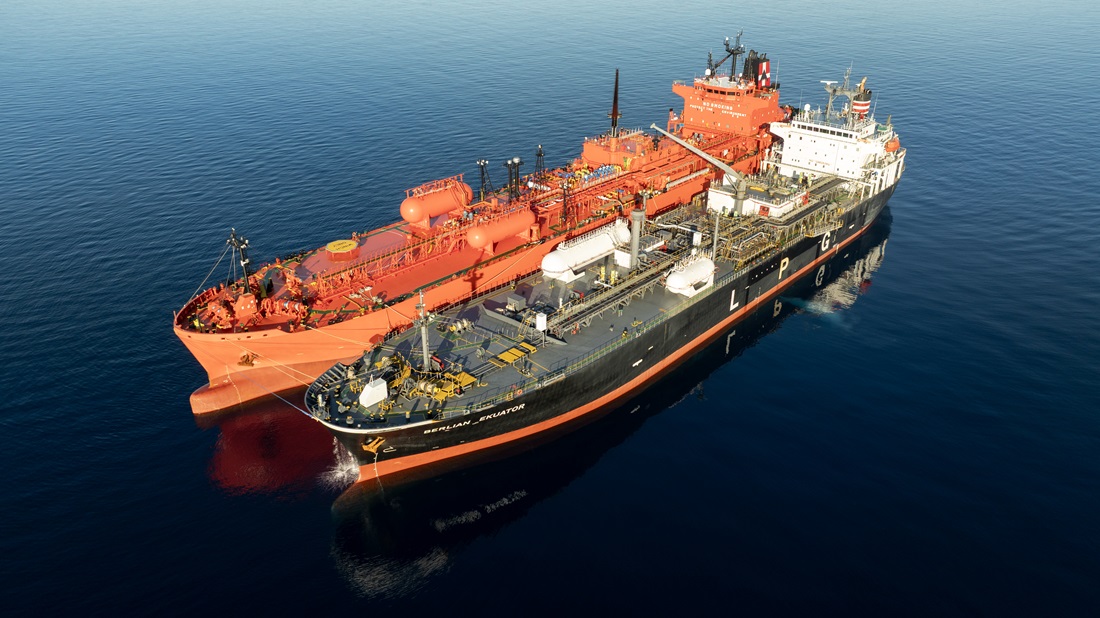
On ships using ammonia as fuel, fixed detectors must monitor fuel preparation rooms, tank connection spaces, bunkering stations, machinery spaces, secondary pipeline enclosures, and other locations where ammonia may accumulate.
In accordance with the IMO Interim Guidelines, audible and visual alarms are to be activated when ammonia vapour reaches a concentration of 110 ppm. At 220 ppm, the safety system must activate the prescribed automatic actions, including stopping the fuel supply and closing the relevant valves.
These values must not be interpreted as permission to remain in a contaminated space without protection. Alarm thresholds form part of the shipboard control system, while crew actions are determined by the emergency procedure, risk assessment, and actual conditions.
After an automatic shutdown, the ammonia supply must not be reopened until the cause of activation has been identified, the system has been inspected, and the necessary safety measures have been taken.
What should a seafarer do after a leak alarm?
An ammonia detection alarm must not be ignored, even if the seafarer cannot see a leak or smell ammonia. The detector may activate before the substance reaches the work area.
After receiving the alarm, it is necessary to:
- stop the current task if this can be done without additional risk;
- do not enter the space where ammonia has been detected;
- leave the hazardous area by the designated route;
- do not open doors, hatches, or other access points unnecessarily;
- report the exact location where the alarm was activated;
- proceed to the designated muster station or safe space;
- perform only the emergency duties assigned in the muster list;
- use protective equipment in accordance with the instructions received and the training provided.
A seafarer must not return for personal belongings, independently search for the damaged area, or attempt to close a valve if this requires entering a toxic zone without appropriate equipment.
Personal protective equipment
Ordinary work coveralls, safety goggles, and gloves do not provide sufficient protection during a serious ammonia leak.
Work in a contaminated space may require:
- a gas-tight protective suit;
- chemically resistant gloves and boots;
- a positive-pressure self-contained breathing apparatus;
- a full-face mask;
- an explosion-proof flashlight;
- a lifeline;
- a two-way portable communication device.
The equipment set must be complete, serviceable, and stored in a clearly marked, accessible cabinet. Before entry, the air supply, suit integrity, communications, and readiness of the backup team must be checked.
For emergency escape from a hazardous area, every person on board must have suitable respiratory and eye protection. In accordance with IMO guidelines, filtering respirators are not permitted as emergency escape equipment from an ammonia zone. Escape equipment must not be used for firefighting, bunkering, or entry into a contaminated space.
Why must a casualty not be rescued without protection?
On seeing an unconscious person in a space, a seafarer may instinctively try to help immediately. In the event of an ammonia leak, entering without protection may result in a second casualty.
The rescue operation must be carried out by a trained team using self-contained breathing apparatus, gas-tight protection, communications, and lifelines. A backup team ready to assist the rescuers must remain at the entrance.
Before entry, the fuel supply must, as far as possible, be stopped remotely, the source of the leak isolated, the designated ventilation or vapour treatment system activated, and gas detector readings checked.
First aid after ammonia exposure
The first action is to stop exposure to the substance and move the casualty to a safe area. The rescuer must not place themselves in danger.
If ammonia contacts the skin or eyes, a decontamination shower or eyewash station must be used as quickly as possible. The affected area must be flushed with plenty of clean water in accordance with the shipboard medical procedure.
Contaminated clothing must be removed carefully so that the substance does not contact the face or clean areas of skin. Clothing should not be pulled over the head if there is a risk of transferring ammonia to the eyes or respiratory tract.
After inhaling ammonia, the casualty may require oxygen support and urgent medical assistance. Even if the condition improves after leaving the contaminated area, medical observation may still be necessary because respiratory damage is not always immediately apparent.
Medical first-aid supplies must be available on board, including oxygen resuscitation equipment, taking into account the recommendations of the Medical First Aid Guide for ammonia.
Hazards during bunkering
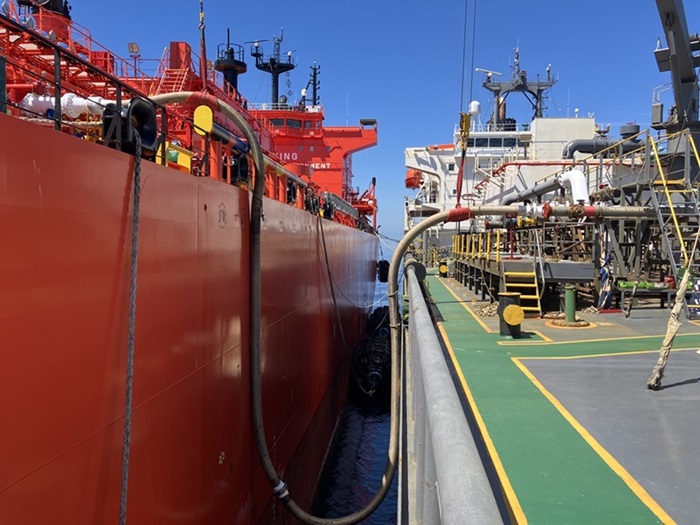
Bunkering is one of the operations with the highest risk of loss of containment. An accident may be caused by an incorrect connection, hose damage, excessive pressure, an error when switching valves, vessel movement, or premature disconnection of equipment.
Before starting the operation, the crew must check:
- the agreed bunkering plan;
- the allocation of duties and communication channels;
- the condition of hoses, connections, and emergency release systems;
- the operation of gas detectors and alarms;
- the readiness of the emergency shutdown system;
- the availability of protective equipment;
- the accessibility of showers and eyewash stations;
- the absence of unauthorised persons and ignition sources;
- clear evacuation routes;
- the procedure for collecting and treating possible ammonia-contaminated effluent.
All participants must know who has the authority to stop the operation. If an unexplained alarm, a leak, a pressure drop, a communication failure, or a hazardous change in the vessel’s position occurs, bunkering must be stopped in accordance with the established procedure.
Ventilation, isolation, and remote shutdown
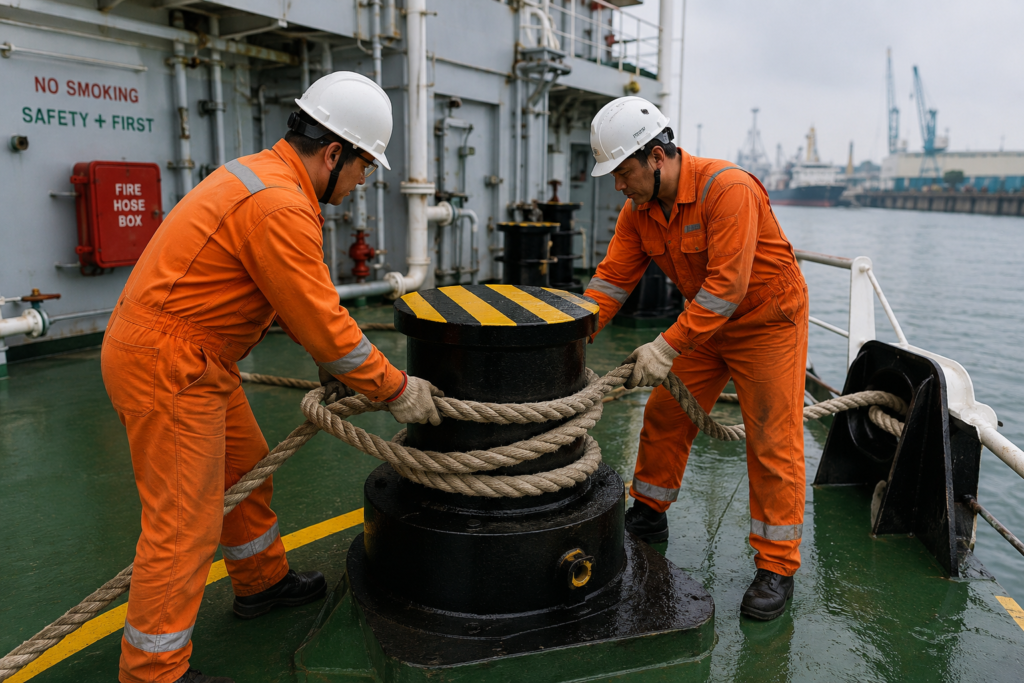
Ventilation is an important part of protection, but it does not replace the integrity of the fuel system. Its purpose is to prevent hazardous vapour accumulation and direct vapours to the designated treatment or discharge location.
Reduced ventilation capacity or loss of ventilation in spaces containing fuel equipment must activate audible and visual alarms. Where required, the system must automatically close the fuel valves.
Remote emergency shutdowns for pumps, compressors, and the fuel supply may be located on the bridge, in the engine control room, in the safety centre, at the fire control station, and near exits from hazardous spaces.
However, pressing an emergency button does not complete the response. The actual closure of valves must be confirmed, ammonia concentrations monitored, the possibility of vapour dispersion assessed, and restart prevented until the cause of the emergency has been established.
Contaminated water also presents a hazard
Ammonia is highly soluble in water. For this reason, water curtains and spray systems may be used as part of the design solution to reduce vapour dispersion.
However, water that has contacted ammonia becomes ammonia-contaminated effluent. It must not be automatically discharged overboard or directed into the ordinary bilge system.
The ship must have an established procedure for collecting, retaining, monitoring, and subsequently treating such effluent. The crew must understand which valves, tanks, and drainage systems are used for this purpose.
What training does the crew need?
Knowledge of the general rules for working with gas fuel is not sufficient. Seafarers must take into account the specific hazards associated with ammonia.
Before beginning shipboard duties, every crew member must be familiarised with the design of the particular ship, the location of the fuel system, toxic areas, alarm signals, emergency routes, and protective equipment.
Seafarers assigned specific duties relating to safety, maintenance of ammonia systems, or emergency response must have appropriate basic training. The master, engineers, and persons directly responsible for fuel, bunkering, storage, and the supply of ammonia require advanced training.
Training must cover:
- the properties of ammonia and its effects on people;
- the design of the shipboard fuel system;
- fuel bunkering, storage, and supply;
- procedures for system start-up, shutdown, and purging;
- detection of gas and liquid leaks;
- automatic and manual emergency shutdowns;
- use of self-contained breathing apparatus;
- work in a gas-tight suit;
- decontamination and first aid;
- firefighting and rescue operations;
- control of ammonia-contaminated effluent and environmental protection;
- risk assessment and permit-to-work procedures.
What drills are required on board?
Theoretical instruction does not prepare a person to work in conditions of poor visibility, alarms, limited time, and high psychological pressure.
During drills, it is advisable to practise:
- responding to a leak alarm in the fuel preparation room;
- evacuation to a safe space;
- remote shutdown of the ammonia supply;
- checking the atmosphere with a portable gas detector;
- preparing the emergency and backup teams;
- donning a gas-tight suit and breathing apparatus;
- locating and removing a simulated casualty;
- decontaminating personnel and equipment;
- providing first aid after inhalation of or contact with ammonia;
- restoring the system only after permission from the responsible person.
After a drill, more than response speed must be assessed. It is important to check the quality of communications, the correctness of routes, the condition of equipment, understanding of alarms, readiness of the backup team, and the crew’s ability to act without dangerous improvisation.
What should a seafarer check after joining the ship?
Familiarisation with the ammonia system must not be postponed until the first drill or emergency alarm.
After joining the ship, the seafarer must determine:
- where the ammonia fuel tanks and pipelines are located;
- which spaces are considered toxic areas;
- what the ammonia detection alarm sounds like;
- where gas detector readings are displayed;
- where emergency shutdown buttons are located;
- the primary and alternative evacuation routes;
- where the safe space is located;
- where breathing apparatus and gas-tight suits are stored;
- where showers and eyewash stations are installed;
- which duties are assigned in the muster list;
- to whom and in what form an emergency report must be made.
What must never be done?
During an ammonia leak, even one incorrect action can increase the number of casualties or spread the toxic cloud into safe spaces.
It is prohibited to:
- ignore a gas-detection alarm because there is no smell;
- enter a contaminated space independently;
- attempt to rescue a person without breathing apparatus and a protective suit;
- open doors or hatches without an instruction;
- silence an alarm without establishing the reason for its activation;
- restart the fuel system without permission;
- use escape equipment for work in a toxic area;
- use unauthorised methods to neutralise the leak;
- direct contaminated water into the ordinary bilge system;
- conceal a malfunction of a detector, valve, or protective equipment;
- repair the ammonia system without isolation, purging, gas testing, and a permit to work.
Why is practical training essential?
During a real emergency, the crew may face a toxic cloud, limited visibility, loud alarms, casualties, blocked passages, and the need to make rapid decisions.
Without practical training, a seafarer may don breathing apparatus incorrectly, confuse an emergency valve, enter a toxic area without a backup team, or open a door through which ammonia will spread further.
Simulator training makes it possible to safely practise leak detection, system isolation, evacuation, use of protective equipment, casualty rescue, and coordination between the bridge, engine room, and emergency teams.
The better the crew knows the system and their own duties, the less time will be lost in a real hazardous situation.
The main points to remember
Ammonia can help the maritime industry reduce the use of carbon-based fuels, but its use creates a new level of safety requirements. The main risk to the crew is toxic exposure, along with chemical and cold burns, fire, explosion, and water pollution caused by ammonia-contaminated effluent.
After a leak alarm, personnel must leave the hazardous area, report the exact location of the alarm, act in accordance with the emergency procedure, and not enter a toxic space without full protective equipment.
Smell does not replace a gas detector, escape equipment does not replace self-contained breathing apparatus, and personal courage does not replace a trained rescue team.
Readiness to work with ammonia does not begin at the moment of an emergency. It begins with training, familiarisation with the ship, equipment checks, and regular practice of actions under difficult conditions.
Sources: International Maritime Organization (IMO), MSC.1/Circ.1687 — Interim Guidelines for the Safety of Ships Using Ammonia as Fuel; STCW.7/Circ.25 — Generic Interim Guidelines on Training for Seafarers on Ships Using Alternative Fuels and New Technologies; Interim Guidelines on Training for Seafarers on Ships Using Ammonia as Fuel, approved by MSC 111 in May 2026; European Maritime Safety Agency (EMSA) — Safety of Ammonia as a Fuel in Shipping; Medical First Aid Guide for Use in Accidents Involving Dangerous Goods (MFAG).